
🔹 What is Direct Speech?
English:
Direct speech means reporting the exact words spoken by someone.
We use quotation marks (" ") to enclose the exact words.
Hindi:
Direct speech वह होता है जब हम किसी व्यक्ति के कहे हुए शब्दों को जैसा का तैसा दोहराते हैं। इसमें inverted commas (" ") का प्रयोग होता है।
Example (English):
-
He said, "I am going to school."
Example (Hindi):
-
उसने कहा, "मैं स्कूल जा रहा हूँ।"
🔹 What is Indirect Speech?
English:
Indirect speech means reporting what someone said without quoting the exact words.
Tense, pronouns, and time expressions usually change.
Hindi:
Indirect speech में हम किसी के बोले हुए शब्दों को अपने शब्दों में कहते हैं। इसमें Tense, Pronoun और Time Expression बदल जाते हैं।
Example (English):
-
He said that he was going to school.
Example (Hindi):
-
उसने कहा कि वह स्कूल जा रहा था।
🔁 Changes from Direct to Indirect Speech
| Direct Speech | Indirect Speech |
|---|---|
| "I am happy," she said. | She said that she was happy. |
| "I will go," he said. | He said that he would go. |
| "They are playing," he said. | He said that they were playing. |
| "I ate lunch," she said. | She said that she had eaten lunch. |
🧠 Key Rules to Remember
-
Remove quotes and use ‘that’ (optional in spoken English).
-
Change tense (present → past, will → would, etc.).
-
Change pronouns according to the subject.
-
Change time words:
-
today → that day
-
tomorrow → the next day
-
now → then
-
yesterday → the day before
- If the reporting verb is in the past tense, then the tense of the reported speech will change as follows:
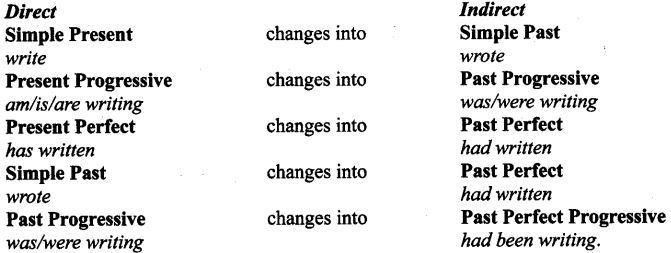
- If the direct speech expresses a historical fact, a universal truth or a habitual fact. tense of the direct speech will not change:
Direct : He said, “Honesty is the best policy.”
Indirect : He said that honesty is the best policy.
Direct : He said, “The sun rises in the east.”
Indirect : He said that the sun rises in the east.
Direct : Rakesh said, “I am an early riser.”
Indirect : Rakesh said that he is an early riser.
Direct : She said, “God is omnipresent.”
Indirect : She said that God is omnipresent.
Direct : The teacher said, “The First World War started in 1914.”
Indirect : The teacher said that the First World War started in 1914.
7. Changing Statements into Indirect Speech:
- The reporting verb “said to’ is changed to ‘told, ‘replied’, ‘‘remarked’,
- The reporting verb is not followed by an object, it is not changed.
- The inverted commas are removed. The conjunction that is used to connect the reporting clause with the reported speech.
- The rules for the change of pronouns, tenses, etc. are followed.
Direct : Ramu said, “I saw a lion in the forest.”
Indirect : Ramu said that he had seen a lion in the forest.
Direct : Satish said to me, “I am very happy here.”
Indirect : Satish told me that he was very happy there.
Direct : He said, “I can do this work.”
Indirect : He said that he could do that work.
Direct : Renu said to me, “I was washing the clothes.”
Indirect : Renu told me that she had been washing the clothes.
Direct : She said, “I am not well.”
Indirect : She said that she was not well.
Direct : He said to Sita, “I have passed the test.”
Indirect : He told Sita that he had passed the test
Direct : I said to my friend, “He has been working very hard.”
Indirect : I told my friend that he had been working very hard.
Direct : My friend said to me, “I shall go to Delhi tomorrow.”
Indirect : My friend told me that he would go to Delhi the next day.
Direct : I said, “I agree to what he said.”
Indirect : I said that I agreed to what he had said.
Direct : The student said to the teacher, “I am sorry that I am late.”
Indirect : The student told the teacher that he was sorry that he was late.
8. Rules for the Change of Interrogative (Questions) sentences:
- The reporting verb ‘say’ is changed into ask, inquire,
- The interrogative sentence is changed into a statement by placing the subject before the verb and the full stop is put at the end of the sentence.
- If the interrogative sentence has a wh-word (who, when, where, how, why, etc) the wh- word is repeated in the sentence. It serves as a conjunction.
- If the interrogative sentence is a yes-no answer type sentence (with auxiliary verbs aw, are, was, were, do, did, have, shall, etc), then if or ‘ whether’ is used as a conjunction.
- The auxiliaries do, does, did in a positive question in the reported speech are dropped.
- The conjunction that is not used after the reporting clause.
Direct : I said to him, “Where are you going?”
Indirect : Tasked him where he was going.
Direct : He said to me, “Will you go there?”
Indirect : He asked me if I would go there.
Direct : My friend said to Deepak, “Have you ever been to Agra?”
Indirect : My friend asked Deepak if he had ever been to Agra.
Direct : I said to him, “Did you enjoy the movie?”
Indirect : I asked him if he had enjoyed the movie.
Direct : I said to her, “Do you know him?”
Indirect : I asked her if she knew him.
Direct : He said to me, “Will you listen to me?”
Indirect : He asked me if I would listen to him.
Direct : I said to him, “When will you go there?”
Indirect : I asked him when he would go there.
Direct : He said to me, “How is your father?”
Indirect : He asked me how my father was.
Direct : I said to him, “Are you happy?”
Indirect : I asked him if he was happy.
Direct : He said to her, “Do you like apples?”
Indirect : He asked her if she liked apples.
9. Changing Commands and Requests into Indirect Speech:
- In imperative sentences having commands, the reporting verb is changed into command, order, tell, allow, request,etc.
- The imperative mood is changed into the infinitive mood by putting to, before the verb. In case of negative sentences, the auxiliary ‘do’ is dropped and ‘to’ is placed after ‘not:
Direct : She said to me, “Open the window.”
Indirect : She ordered me to open the window.
Direct : The captain said to the soldiers, “Attack the enemy.”
Indirect : The captain commanded the soldiers to attack the enemy.
Direct : I said to him, “Leave this place at once.”
Indirect : I told him to leave that place at once.
Direct : The teacher said to the students, “Listen to me attentively.”
Indirect : The teacher asked the students to listen to him attentively.
Direct : The Principal said to the peon, “Ring the bell.”
Indirect : The Principal ordered the peon to ring the bell.
Direct : The master said to the servant, “Fetch me a glass of water.”
Indirect : The master ordered the servant to fetch him a glass of water.
Direct : I said to him, “Please bring me a glass of water.”
Indirect : I requested him to bring me a glass of water.
Direct : I said to my friend, “Please lend me your book.”
Indirect : I requested my friend to lend me his book.
Exercise (Solved)
Change the following sentences into Indirect Speech:
(i) He said, “I will do it now.”
Answer:
He said that he would do it then.
(ii) He says, “Honesty is the best policy.”
Answer:
He says that honesty is the best policy.
(iii) Ramesh says, “I have written a letter.”
Answer:
Ramesh says that he has written a letter.
(iv) She said, “Mahesh will be reading a book.”
Answer:
She said that Mahesh would be reading a book.
(v) She said, “Where is your father?”
Answer:
She inquired where his father was.
(vi) He said to me, “Please take your book.”
Answer:
He requested me to take my book.
(vii) The Principal said to the peon, “Let this boy go out.”
Answer:
The Principal ordered the peon to let that boy go out.
(viii) He said to me, “May you live long!”
Answer:
He prayed that I might live long.
(ix) She said, “Goodbye friends!”
Answer:
She bade goodbye to her friends.
(x) The students said, “Alas! I wasted my time last year.”
Answer:
The students regretted that he had wasted his time the previous year.


No comments:
Post a Comment