
1. State similarities and differences between the laboratory thermometer and the clinical thermometer.
Ans: Similarities include the use of mercury and the measurement of temperature.
Differences include clinical thermometers have a kink to prevent the temperature from dropping, but laboratory thermometers do not have a kink.
In comparison to clinical thermometers, the range of a laboratory thermometer is extremely broad.
2. Give two examples each of conductors and insulators of heat.
Ans:
3. Fill in the blanks:
a. A cold steel spoon is dipped in a cup of hot milk. It transfers heat to its other end by the process of ________.
Ans: Conduction.
b. Temperature is measured in degrees _________.
Ans: Celsius.
c. No medium is required for transfer of heat by the process of _________.
Ans: radiation.
d. Clothes of _________ colours absorb heat better than clothes of light colours.
Ans: black
e. The hotness of an object is determined by its _________.
Ans: Temperature.
f. Temperature of boiling water cannot be measured by a __________ thermometer.
Ans: clinical
4. Match the following:
i. Land breeze blows during a. summer
ii. Sea breeze blows during b. winter
iii. Dark coloured clothes are
preferred during c. day
iv. Light coloured clothes are
preferred during d. night
Ans:
5. Discuss why wearing more layers of clothing during winter
Ans: When more than one layer of clothing is worn, air gets trapped between them. Heat does not transmit well through air. As a result, the insulation improves and we are more comfortable.
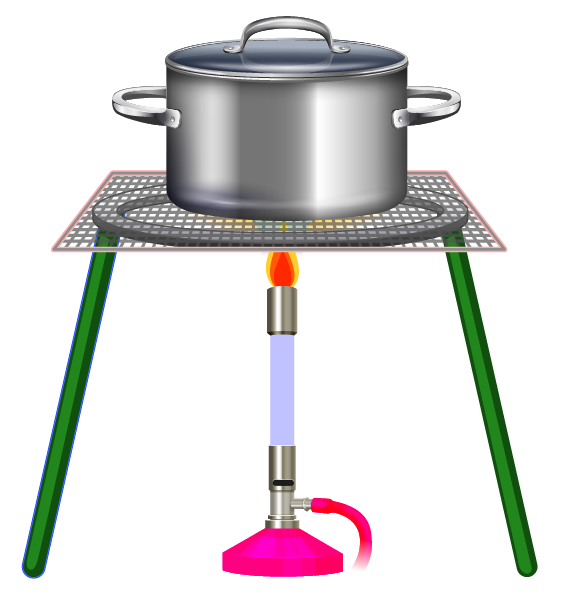
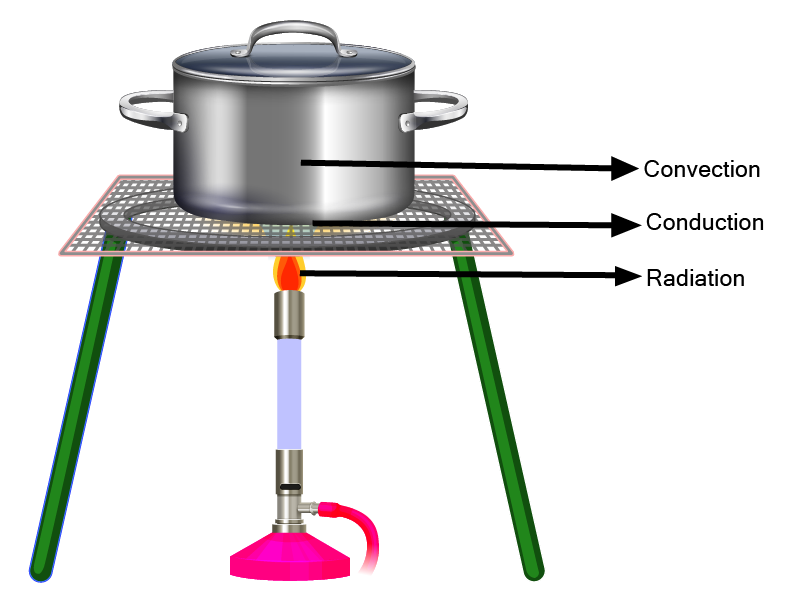
6. Look at Fig. 4.2. Mark where the heat is being transferred by conduction, by convection and by radiation.
Ans:
7. In places of hot climate, it is advised that the outer walls of houses be painted white. Explain.
Ans: White-surfaced objects radiate more heat and absorb less. As a result, less outside heat would enter the house.
8. One liter of water at 3000C is mixed with one liter of water at 5000C. The temperature of the mixture will be
a. 8000C
b. More than 5000C
c. 2000C
d. Between 3000C and 5000C
Ans: d. The temperature lies between 3000C to 5000C. As it is a mixture of waters boiled at two different temperatures.
9. An iron ball at 4000C is dropped in a mug containing water at 4000C the heat will
a. Flow from iron ball to water.
b. Not flow from iron ball to water or from water to iron ball.
c. Flow from water to iron ball.
d. Increase the temperature of both.
Ans: b. Not flow from iron ball to water or from water to iron ball. It is due to the fact that both the substances, the water and the iron have the same temperature.
10. A wooden spoon is dipped in a cup of ice cream. Its other end
a. becomes cold by the process of conduction.
b. becomes cold by the process of convection.
c. becomes cold by the process of radiation.
d. does not become cold.
Ans: d. does not become cold. Heat conducts poorly through a wooden spoon. Its opposite end does not grow cold even if it is dipped in a cup of ice cream.
11. Stainless steel pans are usually provided with copper bottoms. The reason for this could be that
a. Copper bottom makes the pan more durable.
b. Such pans appear colourful.
c. Copper is better conductor of heat than the stainless steel.
d. copper is a better conductor of heat than the stainless steel.
Ans: c. Copper is a better conductor of heat than stainless steel. Copper bottoms are commonly included with stainless steel cookware. Copper is a superior heat conductor than stainless steel, which could be the reason.
Topics Covered in Class 7th Science Chapter 3 Heat
कक्षा 7 विज्ञान अध्याय 3 – ऊष्मा के लिए एनसीईआरटी समाधान
1. प्रयोगशाला थर्मामीटर और चिकित्सीय थर्मामीटर में समानताएं और भिन्नताएं बताइए।
उत्तर:
समानताएं: दोनों थर्मामीटर पारे का उपयोग करते हैं और तापमान मापते हैं।
भिन्नताएं: चिकित्सीय थर्मामीटर में तापमान को गिरने से रोकने के लिए एक मोड़ (kink) होता है, जबकि प्रयोगशाला थर्मामीटर में यह नहीं होता।
प्रयोगशाला थर्मामीटर की सीमा चिकित्सीय थर्मामीटर की तुलना में अधिक होती है।
2. ऊष्मा के चालक और कुचालक के दो-दो उदाहरण दीजिए।
उत्तर:
चालक:
-
तांबा
-
लोहा
कुचालक:
-
रबर
-
सिरेमिक
3. रिक्त स्थान भरिए:
a. एक ठंडा स्टील का चम्मच गरम दूध के कप में डुबोया गया। यह ऊष्मा को अपनी दूसरी ओर ________ प्रक्रिया द्वारा पहुंचाता है।
उत्तर: संचरण (Conduction)
b. तापमान की माप ________ डिग्री में की जाती है।
उत्तर: सेल्सियस (Celsius)
c. ऊष्मा के स्थानांतरण के लिए _________ प्रक्रिया में किसी माध्यम की आवश्यकता नहीं होती।
उत्तर: विकिरण (Radiation)
d. _________ रंगों के कपड़े हल्के रंगों की तुलना में ऊष्मा को अधिक अवशोषित करते हैं।
उत्तर: काले (Black)
e. किसी वस्तु की गर्मी का निर्धारण उसके _________ से होता है।
उत्तर: तापमान (Temperature)
f. उबलते पानी का तापमान __________ थर्मामीटर से नहीं मापा जा सकता।
उत्तर: चिकित्सीय (Clinical)
4. मिलान कीजिए:
i. स्थल समीर बहती है –
उत्तर: रात (d. night)
ii. समुद्री समीर बहती है –
उत्तर: दिन (c. day)
iii. गहरे रंग के कपड़े पसंद किए जाते हैं –
उत्तर: सर्दी (b. winter)
iv. हल्के रंग के कपड़े पसंद किए जाते हैं –
उत्तर: गर्मी (a. summer)
5. सर्दियों में अधिक परतों वाले कपड़े पहनने की सलाह क्यों दी जाती है?
उत्तर: जब हम एक से अधिक परतों वाले कपड़े पहनते हैं, तो उनके बीच की हवा फंस जाती है। हवा ऊष्मा का कुचालक होती है, जिससे ऊष्मा बाहर नहीं निकलती और शरीर गर्म बना रहता है। इससे गर्मी बनी रहती है और आराम मिलता है।
6. चित्र 4.2 को देखिए। इसमें दिखाइए कि ऊष्मा का स्थानांतरण संचरण, संवहन और विकिरण द्वारा कहाँ हो रहा है।
उत्तर:
चित्र में ऊष्मा का स्थानांतरण तीनों विधियों — संचरण (Conduction), संवहन (Convection) और विकिरण (Radiation) — द्वारा हो रहा है।
7. गर्म जलवायु वाले क्षेत्रों में घर की बाहरी दीवारों को सफेद रंग से रंगने की सलाह क्यों दी जाती है?
उत्तर: सफेद सतह वाले वस्तुएं कम ऊष्मा अवशोषित करती हैं और अधिक विकिरण करती हैं। इसलिए बाहरी गर्मी घर में कम प्रवेश करती है और घर ठंडा रहता है।
8. 300°C के एक लीटर पानी को 500°C के एक लीटर पानी से मिलाया गया। मिश्रण का तापमान होगा:
a. 800°C
b. 500°C से अधिक
c. 200°C
d. 300°C और 500°C के बीच
उत्तर: d. 300°C और 500°C के बीच। दोनों विभिन्न तापमान वाले पानी के मिलने पर तापमान बीच में होगा।
9. एक 400°C गर्म लोहे की गेंद को 400°C तापमान वाले पानी के मग में डाला गया। ऊष्मा का प्रवाह
a. लोहे की गेंद से पानी की ओर होगा।
b. न तो लोहे की गेंद से पानी की ओर और न ही पानी से गेंद की ओर ऊष्मा का प्रवाह होगा।
c. पानी से लोहे की गेंद की ओर होगा।
d. दोनों का तापमान बढ़ेगा।

उत्तर: b. कोई ऊष्मा का प्रवाह नहीं होगा क्योंकि दोनों का तापमान समान है।
10. एक लकड़ी का चम्मच आइसक्रीम के कप में डुबाया गया। इसका दूसरा सिरा:
a. संचरण द्वारा ठंडा हो जाएगा।
b. संवहन द्वारा ठंडा हो जाएगा।
c. विकिरण द्वारा ठंडा हो जाएगा।
d. ठंडा नहीं होगा।
उत्तर: d. ठंडा नहीं होगा क्योंकि लकड़ी ऊष्मा का कुचालक है।
11. स्टेनलेस स्टील के बर्तनों में सामान्यतः तांबे की तह क्यों होती है?
a. तांबे की तह से बर्तन टिकाऊ बनता है।
b. ऐसे बर्तन रंगीन दिखते हैं।
c. तांबा स्टेनलेस स्टील से बेहतर ऊष्मा चालक है।
d. उपरोक्त सभी।
उत्तर: c. तांबा ऊष्मा का बेहतर चालक होता है इसलिए इसे बर्तनों की तली में लगाया जाता है।


No comments:
Post a Comment